A lamb that suddenly starts jumping forward while treadmilling backward is easy to label stubborn. That label can send a family in exactly the wrong direction: more speed, more restraint, more incline, and more repetitions until he “gets over it.” But if he worked cleanly before and the behavior appeared recently, begin with a better assumption: something changed.
That change may be the treadmill, the lamb, or the difficulty of the job. Your first goal is not to win the argument. It is to find the point where correct movement disappeared—and avoid rehearsing the wrong response.
Mistake 1: Drilling Through the Jump
When a lamb jumps, scrambles, or launches forward, that repetition is already over. Continuing to drive the belt while he fights for balance does not teach better backward movement. It gives him another opportunity to practice jumping.
Training works through repetition, including repetition of behavior you do not want. If every loss of balance ends with pulling, scrambling, and panic, the lamb can begin anticipating that sequence as soon as he steps onto the treadmill. Training also works through consequences: if jumping reliably makes the belt and the entire workout stop, the lamb can learn that jumping is an effective escape response. That does not mean keeping the belt moving during an unsafe struggle. It means treating the jump as an emergency interruption, not automatically as the final act of the session.
Washington State University’s showmanship guidance makes the same broader training point: reward correct performance and avoid overworking a lamb, which can create fatigue and bad habits (extension.wsu.edu).
The goal is not to make the lamb finish the rep. The goal is to make every finished rep worth repeating.
Stop the belt, settle him, and reassess. Correct any pain, footing, or equipment problem and lower the difficulty. If the lamb is sound and calm, restart at an easier setting and seek a very brief stretch of correct movement before ending, so the last safe repetition is one worth repeating. If pain, fear, or unsafe behavior persists, end the session rather than forcing another repetition.
Mistake 2: Blaming Attitude Before Checking the Setup
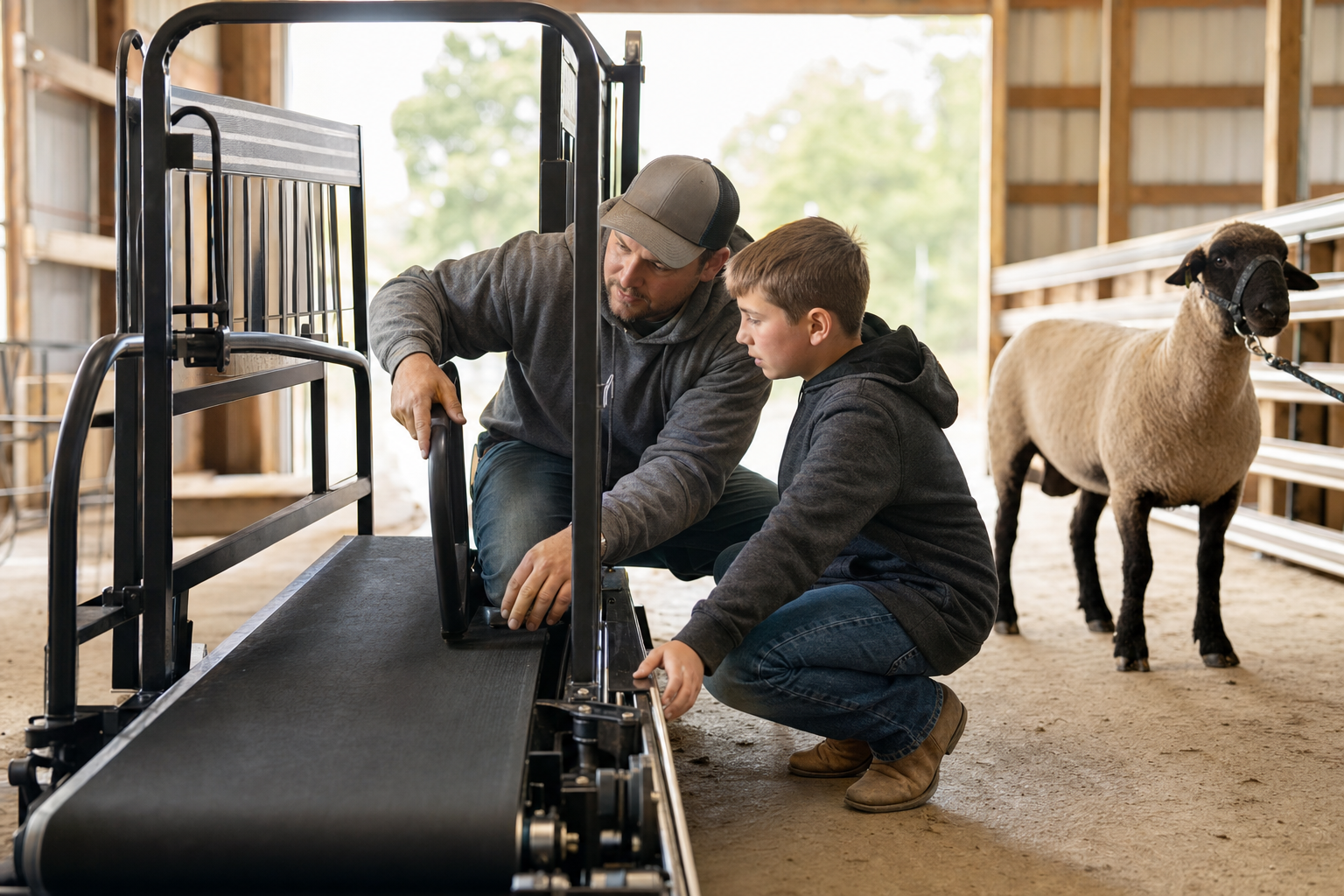
A recent behavior change deserves a physical and mechanical check before an “attitude adjustment.”
Start with the treadmill:
- Watch for a belt surge, hesitation, or slick spot.
- Confirm that the incline has not changed.
- Check whether a side rail or panel is rubbing him.
- Look for loose footing where he enters or exits.
- Run the belt empty and listen for a new sound or vibration.
Then watch the lamb on level ground. Lead him forward, back him several steps, and make a slow turn in each direction. Look for a tender toe, long or uneven hoof, short backward step, sore hock, or reluctance to load one hind leg.
You are not trying to diagnose a lameness problem in the barn aisle. You are deciding whether exercise should stop. If he remains uneven, repeatedly protects a foot, has swelling or heat, or appears painful, pause the treadmill work and involve your veterinarian.
Mistake 3: Cranking Up the Head
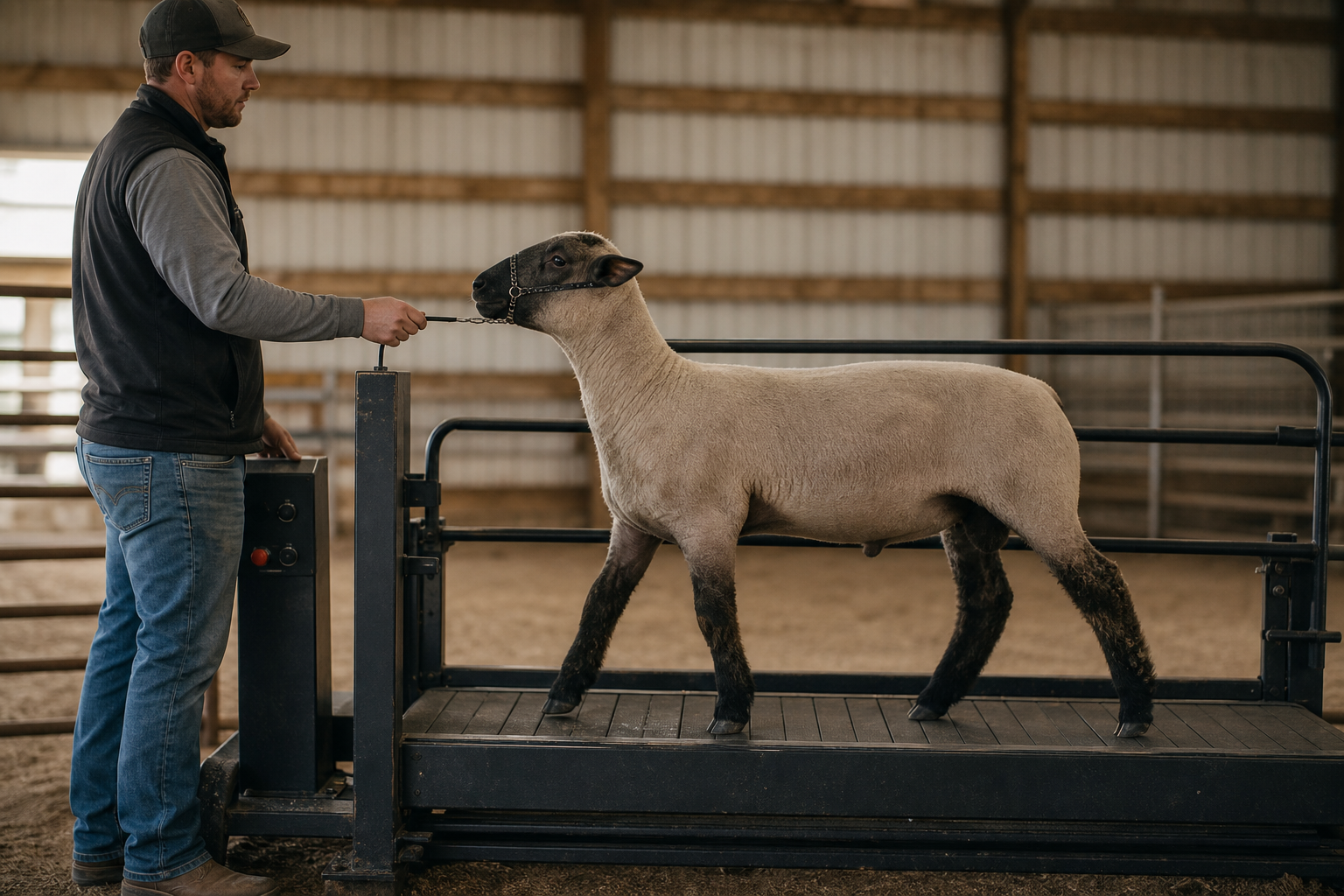
Head position affects the rest of the lamb. Too much upward or backward pressure can shorten his stride, stop forward motion, and trigger resistance. Oklahoma State University advises leading with the head high enough for an appealing but natural walk and cautions against pulling up on the neck (extension.okstate.edu).
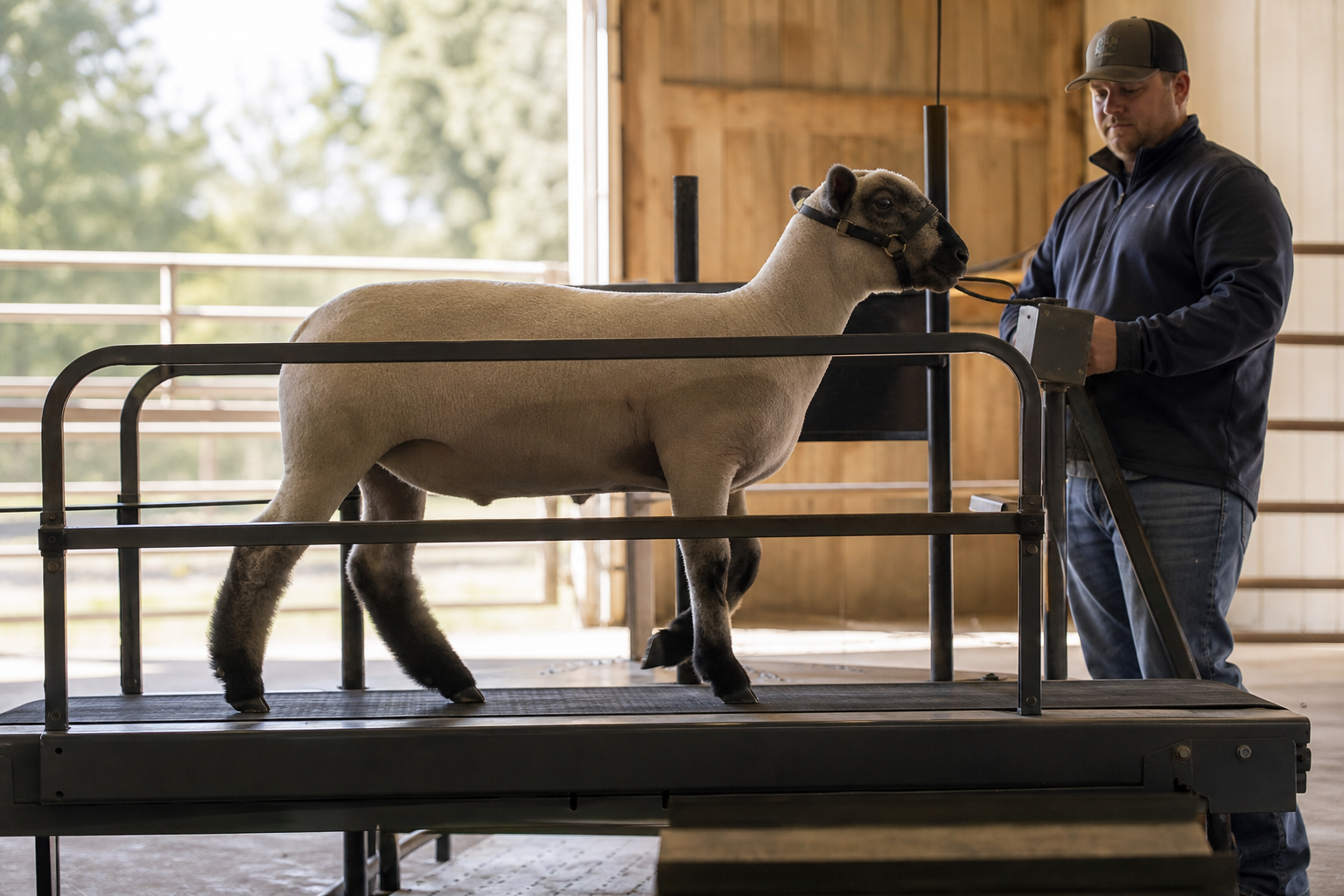
On the treadmill, use steady, light halter contact. Keep him straight and attentive without folding his neck backward or making the halter a handrail.
When he jumps, resist the reflex to pull harder. Heavy pressure from the front while the belt moves beneath him can turn a coordination mistake into a tug-of-war. Stop the belt first. Regain a quiet position. Then either restart at an easier setting or end the session.
Mistake 4: Adding Every Challenge at Once
Backward movement is already a coordination task. Changes in speed, duration, or grade can alter footing and workload. Change all three together and you will not know which one caused the breakdown.
Use foot placement as the governor—not the treadmill display and not what another lamb can do.
For a lamb that has recently started jumping, this is a reasonable reset:
There is no universal conditioning prescription. Treadmills differ, and so do lambs. A slower belt may be plenty for one lamb and awkward for another. Correct, controlled steps matter more than completing a predetermined clock.
Know When the Session Is Done
Fatigue often appears before a dramatic refusal. Watch for shortened steps, repeated toe dragging, drifting sideways, a rising head, a hollowed back, or a lamb that needs steadily more halter pressure to stay in position.
That is your stopping point. Conditioning cannot correct soreness, poor footing, or movement that the lamb can no longer coordinate. Harder work is not automatically better work, and a treadmill cannot manufacture progress from bad repetitions.
Keep an adult at the controls, maintain a clear emergency stop, and never leave a lamb unattended on a moving treadmill. If he falls, becomes trapped, or repeatedly launches forward, stop immediately rather than trying to save the set.
The best treadmill session may look almost boring: quiet entry, controlled feet, short clean sets, and a calm exit. That is how you build confidence without teaching a fight.
- A sudden jump is a reason to inspect the treadmill and the lamb—not automatically an attitude problem.
- Stop safely when correct foot placement breaks down; if the lamb is sound and calm, seek a brief stretch of correct movement before ending.
- Use light halter contact and avoid cranking the lamb’s head upward or backward.
- Rebuild with brief attempts, changing only one variable after repeated clean work.